
Kitchen towel buyer guide
Kitchen towels from India: types, sizes and specs
A kitchen towel is six different products. A bar mop that soaks up a spill on a pass is a poor glass cloth, and a lint-free glass cloth is slow on wet hands. This guide sets out each type, the specs that matter, and what to write in your RFQ.
We're adding this line to our panel of partner mills. We quote it against your spec: MOQ, price and lead time come with the quote, after a sample. The figures on this page are typical industry specifications, not a promise of ours, and we confirm each one against a mill sample before you order.
Which kitchen towel for which job
| Type | Construction | Typical GSM | Typical size | Best for | Watch for |
|---|---|---|---|---|---|
| Glass cloth | Plain or herringbone, flat-woven cotton or linen union | 160–200 | 50×70 cm | Polishing glassware and cutlery | Low absorbency on wet hands |
| Huckaback | Huck weave with small raised floats | 180–240 | 45×70 or 50×70 cm | General drying in catering kitchens | Shrinks more than plain weave if not pre-shrunk |
| Waffle | Honeycomb weave | 220–320 | 50×70 cm | Fast drying, absorbent, retail sets | Cells flatten if tumble-dried too hot |
| Flour sack | Light, open plain-weave cotton | 120–160 | 28×28 or 30×30 in | US retail, covering dough, lint-free drying | Feels thin before the first wash |
| Terry kitchen towel | Looped pile, like a hand towel | 350–450 | 40×60 or 50×70 cm | Hands and spills | Sheds lint when new; not for glass |
| Bar mop | Ribbed or looped terry | Sold by weight per dozen | 16×19 in | Wiping spills on bars and passes | Specify weight per dozen, not GSM |
Typical industry figures. We confirm GSM and size against a mill sample before you order.
Colour and pattern: three ways to do it
| Method | How it is made | Holds up to | Best for |
|---|---|---|---|
| Yarn-dyed stripe or check | Yarn is dyed before weaving, so the colour runs through the cloth | Hot washing and repeated laundering | Commercial kitchens, classic striped tea towels |
| Reactive print | Dye bonds with the cotton fibre after weaving | Normal home washing; fades slowly with bleach | Retail designs, souvenir and gift towels |
| Pigment print | Colour sits on the surface in a binder | Fewer washes; can stiffen the hand | Promotional runs where cost matters most |
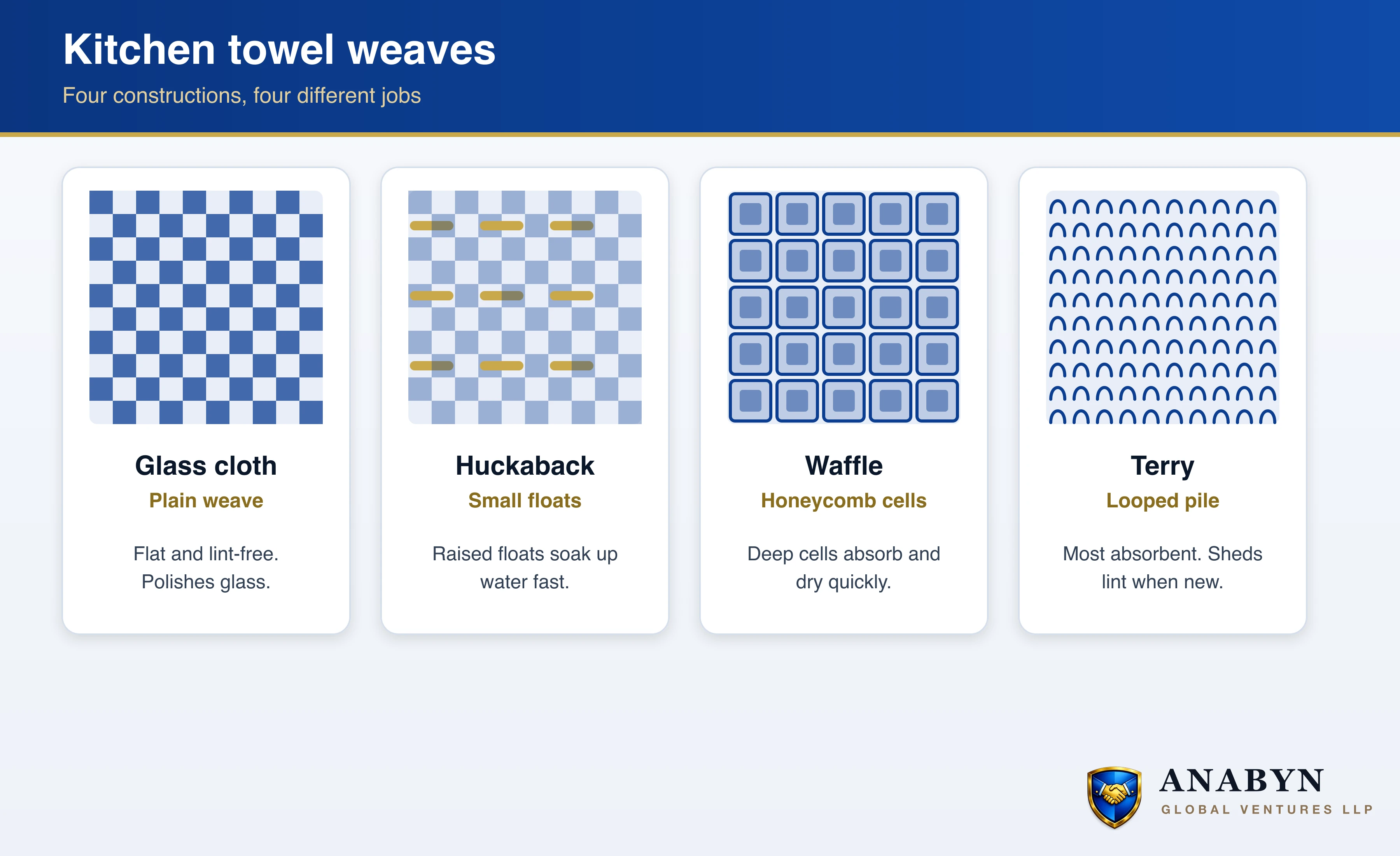 Tap to enlarge
Laundering in a commercial kitchen
- White cotton tolerates hot washes and chlorine bleach. Coloured towels should use oxygen bleach, or the colour fades.
- Yarn-dyed stripes keep their colour longer than prints under hot, frequent washing.
- New terry and bar mops shed lint. Wash before first use and keep them away from glassware.
- Cotton shrinks on the first wash. Ask for the shrinkage figure from the sample wash test and order the size you need after shrinkage.
Packing options to specify
- Retail: sets of 2, 3 or 5 with a belly band or header card, barcode and care label.
- Hanging loop in a corner or the centre of one hem.
- Commercial: bundles of 10 or 12 (bar mops by the dozen) in a polybag, then export cartons.
- Carton marks: PO number, item, quantity per carton, carton number.
OEKO-TEX is available only through a certified partner mill. We show you the certificate number and scope before you order. We make no other certificate claim for this line.
Write your RFQ
What to put in your enquiry
- Type and construction (for example huckaback, 100% cotton)
- GSM, or weight per dozen for bar mops
- Finished size in cm or inches, with tolerance
- Colour method: yarn-dyed, reactive print or plain; Pantone or design file
- Hem, corner finish and hanging loop
- Labels: care, fibre content, brand
- Packing: set size or bundle, barcode, carton marks
- Quantity per design and colour
- Destination market (care-label rules differ) and Incoterm
Missing a detail? Send what you have. We ask for the rest before we quote.
Request a sample and quote
Inside the sheet
Fill in one sheet per restaurant, bar or banquet room. Measure the tables, choose the drop, and write the quantities you hold today. It works for any supplier. Send it with your enquiry and the quote comes back against your exact spec.
Free buyer kit
F&B Linen Spec Sheet
One page per outlet: tables, cloths, napkins, aprons and kitchen towels, ready to send as an RFQ to any supplier.
- Outlet (3 checks)
- Tables and tablecloths (5 checks)
- Napkins, runners, placemats (3 checks)
- Aprons and kitchen linen (3 checks)
- Before you send (3 checks)
No sign-up. Works for any supplier, not just us.
Questions buyers ask
What is the best fabric for kitchen towels?
It depends on the job. Flat-woven glass cloths in cotton or linen union are lint-free for glassware. Huckaback and waffle dry hands and dishes quickly. Terry is the most absorbent but sheds lint when new. Most kitchens use two types: one lint-free, one absorbent.
What size is a standard kitchen towel?
50×70 cm is the common European size. 45×70 cm is common for huckaback. US flour sack towels are usually 28×28 or 30×30 inches, and bar mops are 16×19 inches.
How are bar mops specified?
By weight per dozen rather than GSM, along with size (usually 16×19 inches) and whether the terry is ribbed or looped. Heavier dozens absorb more and last longer in commercial laundry.
What is the HS code for kitchen towels?
Kitchen linen of cotton terry falls under HS 6302.60. Other cotton kitchen linen, such as flat-woven glass cloths and huckaback, falls under 6302.91. Confirm the full tariff line with your customs broker for your market.
Do you sell kitchen towels now?
We're adding kitchen towels to our panel of partner mills. Send your spec and quantity: we arrange a sample and confirm MOQ, price and lead time with the quote.